The story
The Ramayana in the circle
Rama in exile, the golden deer, Sita taken, Hanuman and the fire, the final battle: the episodes of the Ramayana a kecak is built from.
Choose a night on Melasti Beach ↗Quick answer
A kecak tells part of the Ramayana, the Hindu epic of Prince Rama. Wikipedia's account of the dance lists the usual arc: Rama and Sita exiled to the forest, a golden deer that lures Rama away, Ravana carrying Sita off, the vulture Jatayu's fight, Hanuman's search, and at last Rama's war with Ravana. A fire scene usually stands for Hanuman burning the city of Lanka. Each company chooses its own scenes, so treat this as a map, not a programme.
An epic told in Bali
The Ramayana reached Indonesia long ago and was retold there. The Javanese Kakawin Ramayana, believed to date from around 870, was developed further on Bali as the Ramakavaca, and scenes from the epic are carved on the balustrades of the ninth-century Prambanan temple in Java. In Bali the story belongs to temple festivals, shadow puppetry and dance. A kecak takes a few of its best-known episodes and plays them out in an hour, with the chorus sitting in for armies, forests and storms.
Exile in the forest
The story the kecak picks up begins in exile. Rama, heir to the throne of Ayodhya, is banished to the wilderness for fourteen years by a promise his father is bound to keep, and his wife Sita and brother Lakshmana go with him. In the kecak this is usually the gentle opening: the three walk through a forest that the chorus makes with their voices and swaying arms. The roles of Rama, Sita and Lakshmana call for smooth, graceful movement, and they are sometimes danced by women.
The golden deer
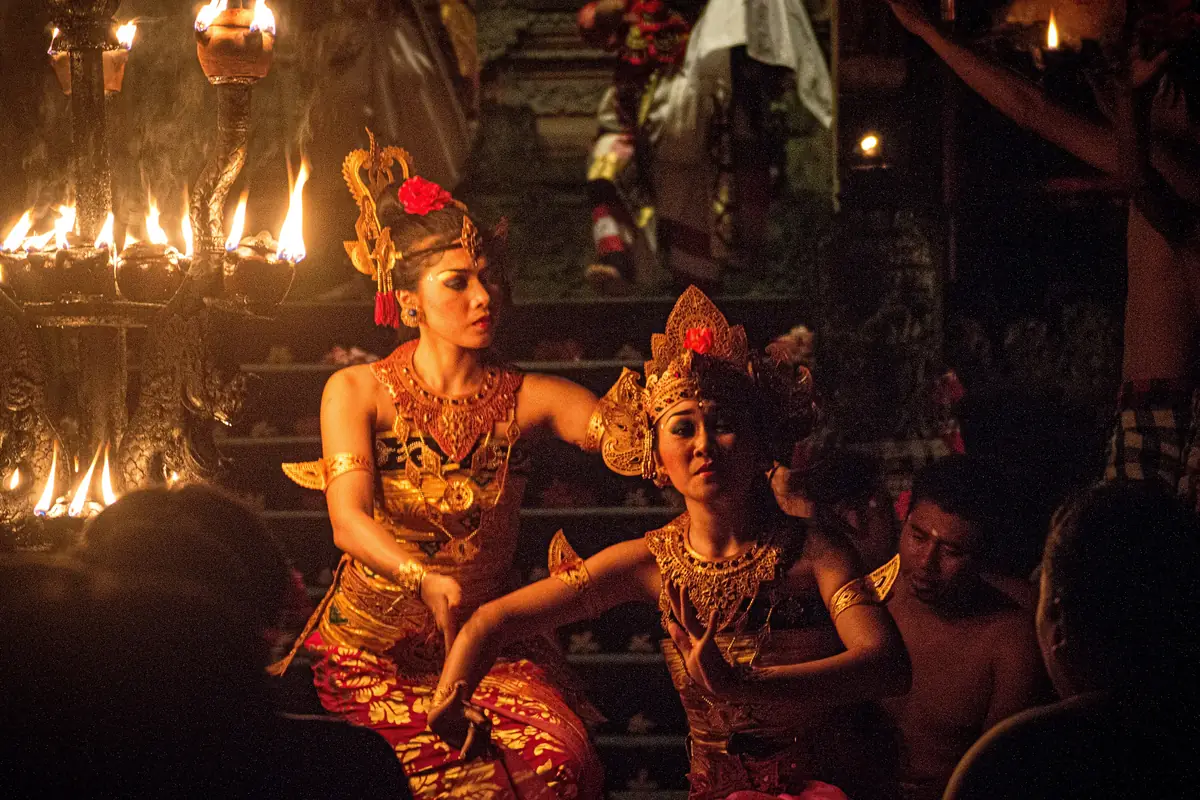
Ravana, the demon king of Lanka, plans to capture Sita and enlists the demon Maricha, who takes the shape of a golden deer. Sita, entranced, begs Rama to catch it, and he follows it deep into the forest, leaving Lakshmana on guard. Then a voice that sounds like Rama's cries out for help, and Sita sends Lakshmana after him. The deer is one of the kecak's lighter roles, often bounding around the circle, and its appearance is the signal that the trap is closing.
Sita taken, and Jatayu
With both brothers gone, Ravana arrives disguised as a wandering ascetic, asks for hospitality and carries Sita off. In Javanese tellings he is Rahwana. The great vulture Jatayu tries to stop him and is mortally wounded in the fight, but lives long enough to tell Rama and Lakshmana what happened. In a kecak the chorus often turns menacing here, switching from forest to Ravana's demon troops. The battle with Jatayu is one of the scenes a kecak commonly includes.
Hanuman and the fire
Rama's search leads him to the monkey hero Hanuman, who makes a vast leap across the sea to Lanka, finds Sita in a grove and gives her Rama's ring as proof that he lives. Captured and brought before Ravana, Hanuman has his tail set alight, breaks free, and sets fire to the city as he leaps across the rooftops. The Balinese kecak includes a fire show to depict this burning of Lanka. It is the moment most audiences remember.
The battle, and the chorus as two armies
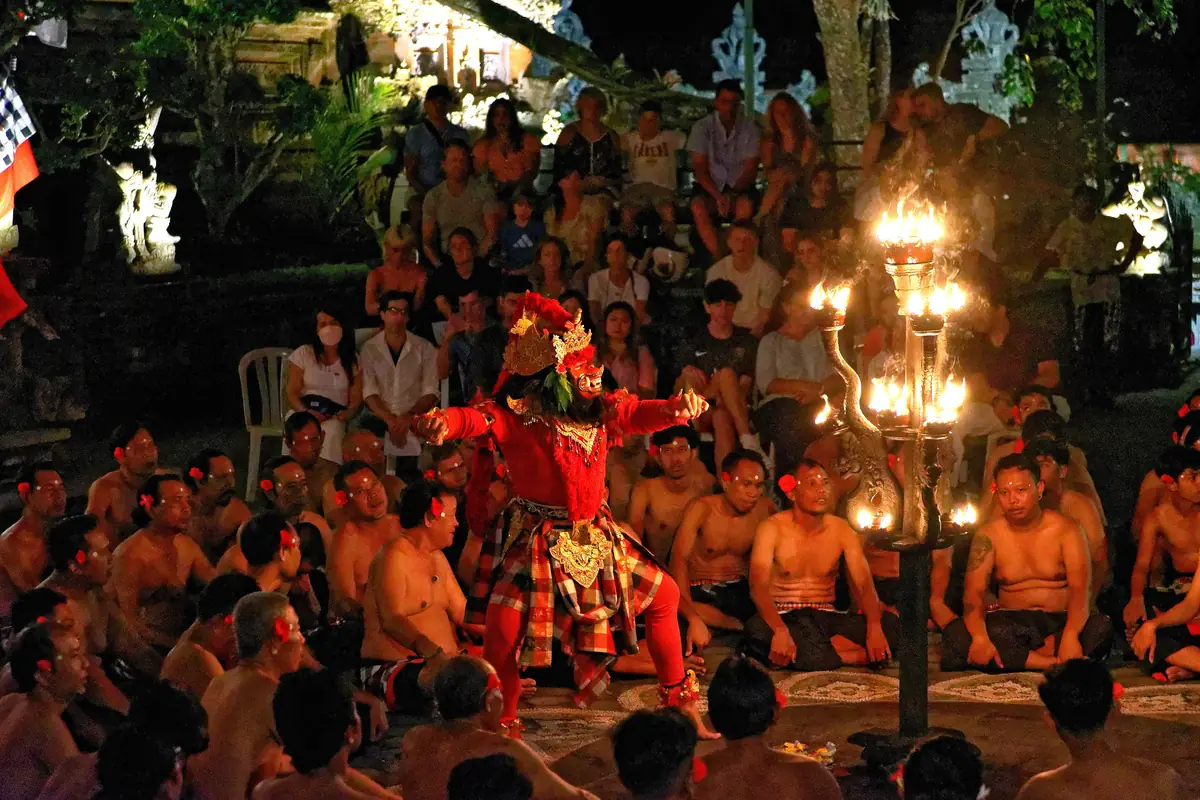
The epic ends in war. Rama's allies build a causeway to Lanka, and Rama finally kills Ravana in battle. In the kecak the men of the chorus play both sides: Rama's army of vanaras, the monkey people, and Ravana's demon rakshasas, changing allegiance with a shift in rhythm, pitch and posture. Some companies close on the triumph, others on Hanuman's fire. If you want to follow the drama, watch which way the chorus leans and how its voice changes; it tells you who is winning.
Sources