The history
Kecak, from trance to stage
How a chorus from a Balinese trance ritual became a Ramayana drama for visitors in the 1930s, and what the kecak is and is not today.
Choose a night on Melasti Beach ↗Quick answer
The kecak is a twentieth-century stage form built on an older ritual. Its chorus comes from sanghyang, sacred Balinese trance dances in which an unseen force is believed to enter the performer. During the 1930s Walter Spies, a painter and musician from Germany, and the Balinese dancer Wayan Limbak shaped the chant into a Ramayana drama for foreign audiences, and Limbak's touring groups made it known abroad. What you watch at Melasti is that stage form.
The ritual roots
Sanghyang dances rest on the belief that a spirit, a hyang, can enter the body of an entranced performer. They are sacred and are performed only at Balinese religious ceremonies, in variants that include girls who dance in trance and a man who takes on the movements of a monkey, accompanied by a chanting chorus. The kecak is described as having its roots in sanghyang, a trance-inducing exorcism dance, and as originally a trance ritual accompanied by a male chorus. That chorus is what survived into the stage show.
The 1930s
Walter Spies, who settled in Ubud in 1927, became deeply interested in the ritual and adapted it as a drama based on the Ramayana, with dance, for Western tourist audiences. He worked with the Indonesian dancer Wayan Limbak, who popularised the kecak by arranging international tours by Balinese groups. The scholar and choreographer I Wayan Dibia puts the emphasis differently: he suggests local performers were shaping the form before Spies ever saw it, and that Limbak had brought baris movements into the role of the chorus leader during the 1920s.
Voices instead of a gamelan
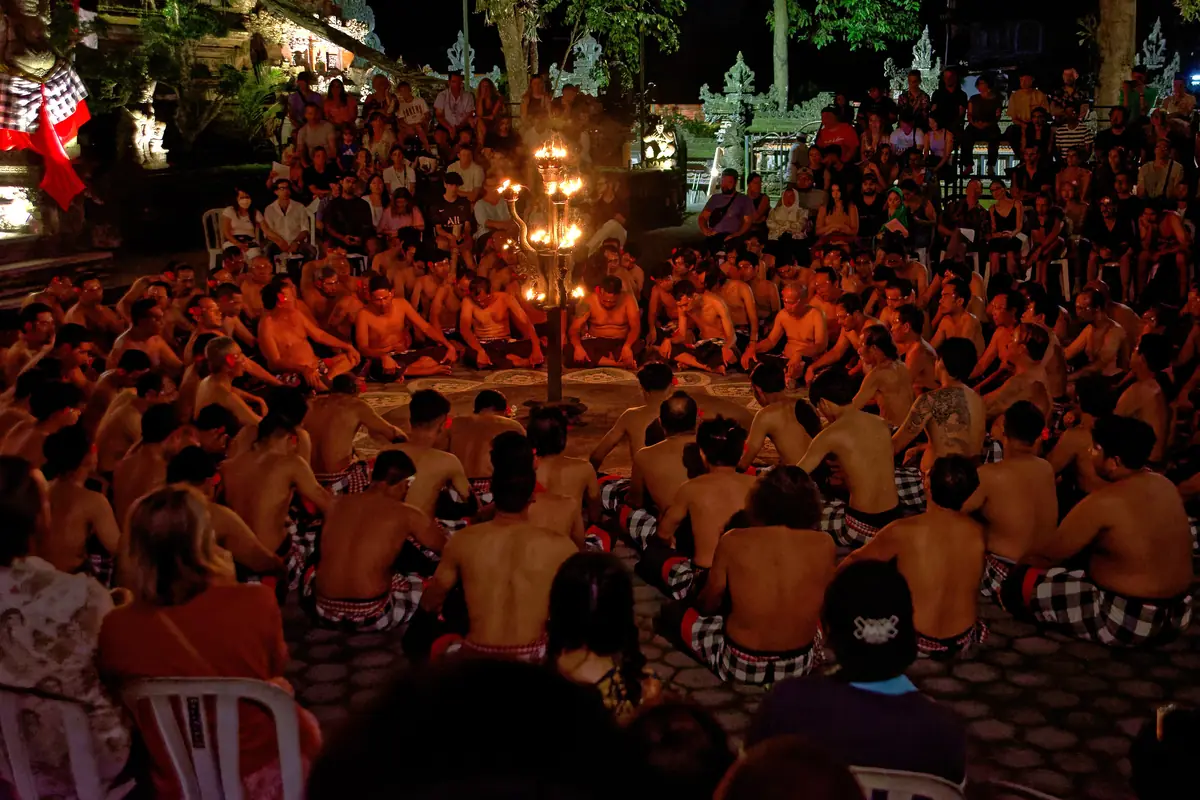
The unusual thing about the kecak, set beside most Balinese dance, is the absence of instruments. Other dance dramas are carried by a gamelan orchestra; the kecak uses only the human voice. Limbak and Spies are credited with replacing the orchestra with the cak chorus, and the Indonesian tourism ministry describes dancers sitting in a circle and chanting the rhythm without gamelan. The chant has become one of the most recognised sounds of Bali, sampled in film soundtracks and pop songs for decades.
Performed for visitors
From the start the kecak was shaped for an audience, and it remains a show. Wikipedia notes that performances take place every evening at the Uluwatu and Tanah Lot temples and on stages built for the kecak elsewhere, including Ubud, the Garuda Wisnu Kencana cultural park and Pandawa Beach. The dancers usually come from nearby villages, often fitting the performance around other work, and are paid from ticket sales. Melasti Beach is one of these stages, run for visitors at sunset.
Still changing
Kecak has been performed mainly by men since its creation, and the first women's kecak group started in 2006. Trance has not vanished entirely: during the burning of Hanuman, the dancer in that role may be blessed by a priest and enter a trance for the fire-kicking dance. Balinese dance as a whole was recognised by UNESCO in 2015 across three genres, from sacred to entertainment, a reminder that in Bali the line between rite and show is drawn with care.
What the kecak is, and is not
It is a living Balinese art form with real ritual roots and a long, much-debated history as a performance for outsiders. It is not a temple ceremony you are being allowed to watch, and it is not centuries old in its current shape. Knowing that does not make the hour less striking; it makes it easier to see what you are hearing. The rings of voices, the trance-born chant and the Ramayana all come from Bali, assembled into a form that has been staged for visitors for nearly a century.
Sources